
Following last year’s Chennai Heritage Walk on the Old Madras Fort Wall by Mr Sriram V, I registered this year too. Today, the walk was in the Royapuram area. I have crossed the Royapuram area but never really seen the places there. After reading about Royapuram Railway Station being one of the Indian subcontinent’s oldest surviving stations, I have wanted to see it.
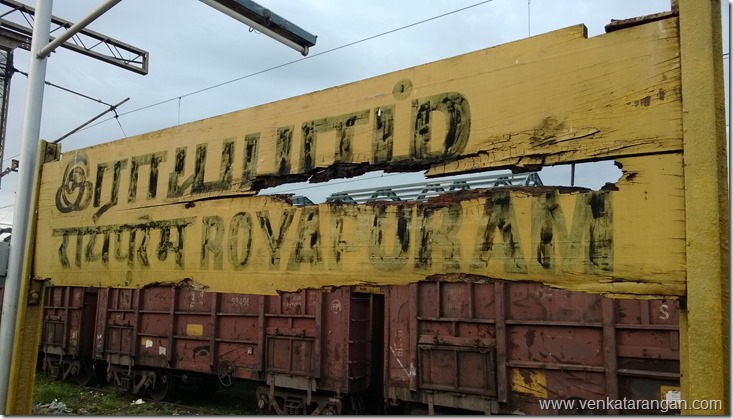
On today’s tour, as usual, Sriram started on time at 6:10 AM, and we all boarded the vans, which first took us to Royapuram Railway Station. The railway station, a significant historic monument, is in a deep state of neglect and at risk of demolition by Southern Railways (the landowner) to develop the area. This area needs development, but not at the expense of throwing away a piece of India’s history.
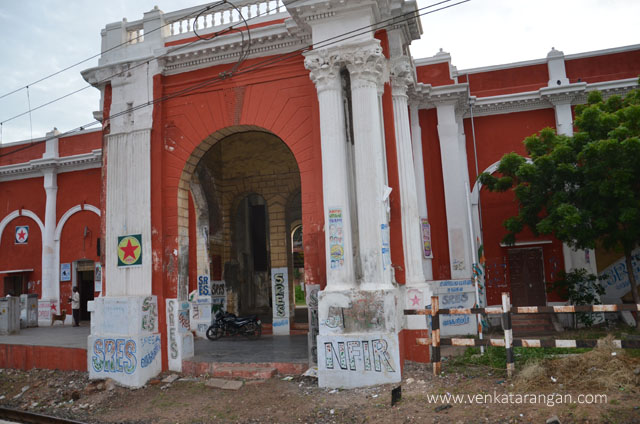
In the early 1850s, the Madras Railway Company (MRC) took up the task of laying railway lines to connect the east and west coasts of India. The arrival of six 13-tonne locomotives by ship from London was a sensation for people in Chennai and an operational marvel, as they had to be unloaded mid-sea into catamarans 2 miles from shore, since Chennai didn’t have a harbour at that time. Wikipedia states that the trains (wagons) were built by Simpsons and Company, but Sriram believes the technology to cast iron wheels was probably not available in India at the time.
The line was thrown open in 1856, and Royapuram remained in full glory till the opening of Central Station in 1873, then gradually losing its importance to Central and Egmore stations as decades went by. Royapuram retains the distinction of being the first railway headquarters in India where Railway Employees went on strike in protest in 1913.
Seeing the dilapidated state of the station today, it is difficult to imagine its glory days 137 years ago, when, on 17 December 1875, the Prince of Wales, later Edward VII, visited the place (which was then converted into a theatre).
Our next stop was St. Peter’s Church on West Mada Church Street, built around 1799 by local residents. The area got its name, Royapuram, as St. Peter was referred to in Tamil as “Rayappar”. In 1799, Lord Edward Clive ordered the Sea Customer (Customs House) to move out of the Fort and to ensure that landings thereafter were only on North Beach (about where the main harbour buildings are today); the boat-owners and their crews, too, had to move. They were granted 720 grounds in lieu of their land in Chepauk, and they put down roots in what is now Royapuram on 5 December 1799. Here they raised a church, and the St. Peter’s Church of today was consecrated in 1829.
Sriram also read a Tamil poem which described the full spelndour and glory of the inauguration ceremony, the poem was from the book “Tamilnadu payana katturaigal” by A.K.CHETTIAYAR.

One of the participants in the walk, who was from the British High Commission,Chennai, mentioned that the architecture of the church was a classic example of Strawberry Hill Gothic architecture.

Near the church were Royapuram Oil tankers. Sriram recollected the stories of how one Mr Haji Sir Ismail Sait brought Kerosene Oil to Chennai, and how the German warship Emden bombed the oil tankers in 1914, causing colossal damage.
Opposite the church was a house belonging to the Missionaries of Charity, where Mother Teresa used to stay during her visits to the city.

Next on the tour were two places of religious importance to the local Parsi community.

One was their cemetery (Parsi Anjuman Bagh), and the other was their Temple of Fire (Jal Phiroj Clubwala Dar-e-Meher), Chennai.

Sriram recounted various Parsis’ connections to the city. One was a shy Parsi girl, clutching a parasol and setting out for a walk. This was the scene in one of Ravi Varma’s paintings, Going Out, with Allamai (Aloo) Khareghat as the subject, and the painting was donated to the Government Museum (Egmore) in 1952. The second was about “Noraji” an officer in Kilpauk Water works to whom Madras owes its Water system. The third was Mary Clubwalla of the Guild of Service.
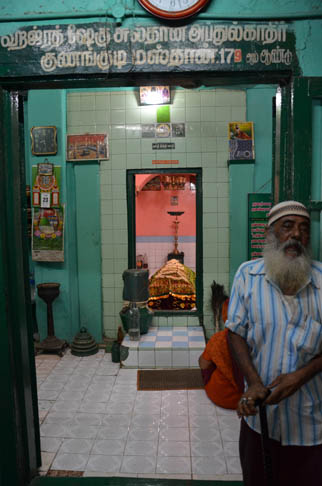
Continuing the tour, we went to the narrow streets of Pichandi Lane, near the cemetery road, to see the Shrine of Hazarath Sheikh Gunangudi Masthan Sahib Dargah (ஹஜ்ரத் ஷேகு சுல்தான் அப்துல்காதிர் குணங்குடி மஸ்தான்). Sriram mentioned that it is generally believed that Tondiarpet got its name from him, but he was not convinced. The shrine contains the resting place of the Sufi saint and it has a small subterranean chamber used by the saint for his meditations, the chamber was 4 to 5 feet below ground level and the caretakers gracefully permitted us to go down into it and come up. The saint has the distinction of having visualised the almighty in female form in his songs, and the famous Tamil Poet Subramanya Bharatayiar (மகாகவி சுப்பிரமணிய பாரதி) is said to have drawn inspiration for his Kannama poems from these works.
The last stop in the tour was the historic Robinson Park (now called Arignar Anna Park). It was here, on 17 September 1949, in front of a huge crowd, that Former Tamil Nadu CM Thiru C.N. Annadurai, along with other stalwarts, founded the DMK, which changed Tamil Nadu politics forever.

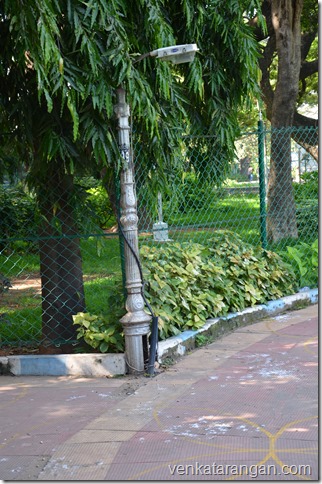
Sriram recounted the history of how the decorative street light posts (you could see some surviving light posts in this park) were installed by the then Congress government, which Thiru C.N.Annadurai raised as an electoral issue.
Opposite this park was the Government RSRM (Raja Sir Ramasamy Mudaliar) Lying-In Hospital, which is now managed by Stanley Medical College.

We ended the tour with a tasty “mini tiffin” breakfast at the nearby Adyar Ananda Bhavan outlet.
Discover more from Mangoidiots.com
Subscribe to get the latest posts sent to your email.
Beautifully compiled ! Nice work Sir.