

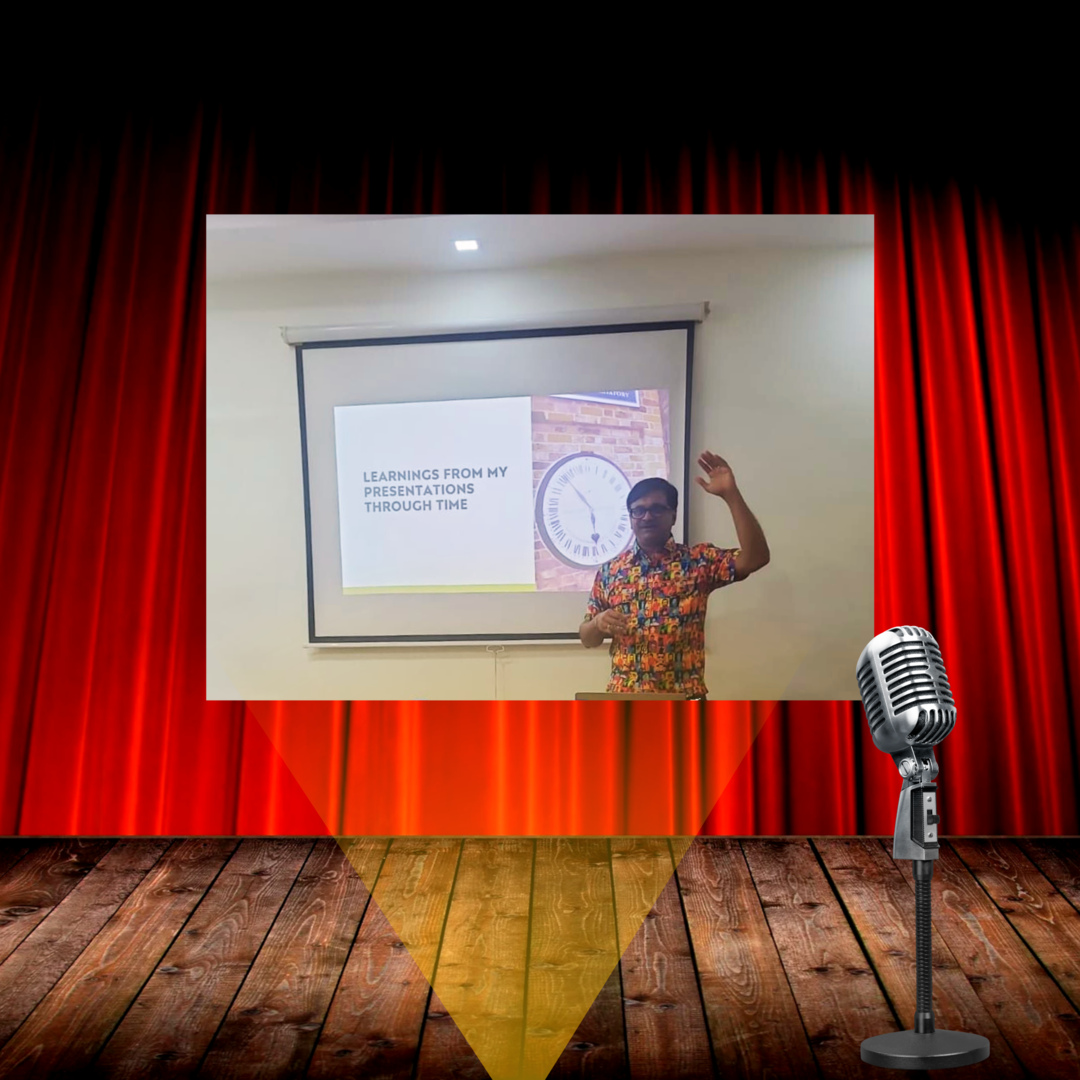
I recently had the unique opportunity to deliver a talk unlike any I’ve given before. It wasn’t about AI, software, or entrepreneurship—the topics I’m usually associated with. Instead, the Chennai Chapter of the Professional Speakers Association of India (PSAI), a distinguished group of speakers in the city, invited me to share my experiences as a speaker. Rather than making it a session centred on myself, I wanted to create an engaging and educational experience that others could learn from. So, I decided to gamify the insights I’ve gathered over nearly three decades of delivering presentations.
That’s how “Learnings from My Presentations Through Time” came to life. My fellow PSAI members resonated as I revisited several cringeworthy moments from my presentations across various cities and countries. I dusted off old OHP (Overhead Projector) plastic-sheet slides from around 1994-95 when I conducted my first public workshop on “Windows NT”. As I progressed, I shared PowerPoint decks from different phases of my professional journey. Together, we dissected the styles, designs, and layouts of these slides, laughing and learning from the missteps and slips along the way.
What struck me was how my presentations served as a fascinating chronicle of design evolution in the technology sector, reflecting the trends that shaped my slide decks over the years. In the early 1990s, my slides were dense with information, featuring bevelled edges and gradient fills—a nod to the emerging graphical interfaces of that era. Then came the infamous “PowerPoint excess” phase, where I, like many others, couldn’t resist the allure of WordArt, ClipArt, and elaborate slide transitions. The early 2000s, influenced by Windows XP and Vista’s Aero interface, saw me incorporating glass-like effects, drop shadows, and pseudo-3D elements. By the mid-2000s, I was embracing the Web 2.0 aesthetic with rounded corners, reflective surfaces, and vibrant colour gradients.
A significant shift happened with the introduction of Apple’s iOS in 2007. I began experimenting with skeuomorphic designs, adding realistic textures and depth that mimicked physical objects. This style dominated my slides until around 2012-2013, when inspiration from Microsoft’s Metro UI and Google’s Material Design led me to adopt flat design principles, emphasizing clean typography, grid systems, and purposeful white space. This was followed by a minimalist phase, where I stripped my slides down to stark black text on white backgrounds—a deliberate reaction against earlier design excesses.
In recent years, I’ve embraced “purposeful design”, combining minimalism with strategic use of colour, typography, and negative space to enhance comprehension. It’s been fascinating to see how my presentation style has evolved alongside broader digital design trends. Revisiting these past decks was not only enjoyable but also highlighted the transformative journey in my own work and within the industry.
In the next part of my talk, I shared some of what I consider to be my best slide-decks and delved into the factors that contributed to their success. Inspired by Phil Waknell’s TED talk, “The 3 Magic Ingredients of Amazing Presentations”, I distilled my insights into three key areas: seeing from the audience’s perspective, refining my role as a speaker, and striving to be transformative in my presentations.
By the end of our interactive session, we distilled eleven key learnings:
- Start with a powerful hook
- Prepare thoroughly and rehearse
- Be concise and focused
- Leverage technology effectively
- Enhance visual storytelling
- Foster interactivity
- Personalize your content
- Master online presentation skills
- Address short attention spans
- Continuously seek feedback and improve
- Practice by recording reels and shorts
We concluded with a thought that resonated with everyone: “A ‘bad’ presentation is never a failure—just a stepping stone to mastery! “
I want to express my gratitude to the organizers and my fellow PSAI members for being the kind of wonderful audience any speaker would cherish.
Discover more from Mangoidiots
Subscribe to get the latest posts sent to your email.