
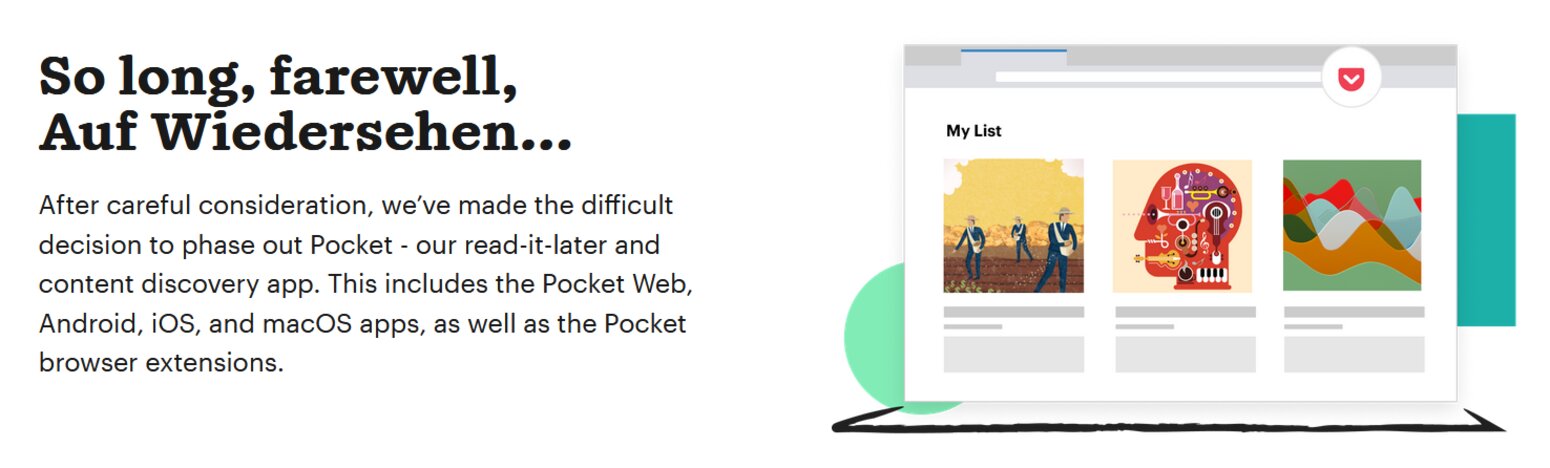
I was quite disappointed to hear the news that Pocket, the well-known web bookmarking service, is shutting down. For me, Pocket has been a reliable companion for more than ten years. Whenever I came across a web page, a product on Facebook, an interesting article I didn’t want to miss, or even a video to watch later, I would save it to Pocket. It didn’t matter whether I was browsing on my phone, tablet, PC, or even in print—Pocket served as my single to-do reading list. Without it, I feel I’ll always have a bit of FOMO, worrying about missing out on something important to read or watch.
Some might ask, why not just use browser bookmarks? The answer is simple. I use different browsers on different devices—on my PC alone, I keep switching between Microsoft Edge and Firefox, not just one. And if I’m reading an article in an app like The Economist, sharing it to a browser bookmark is simply too much trouble. Pocket, on the other hand, makes it easy; the “Share to Pocket” option works smoothly across platforms.
Another thing I will miss is Pocket’s social discovery feature. I have always found their recommendations—both through email and on the homepage—to be in sync with my interests. In fact, I usually end up reading the articles suggested by Pocket. I am also a fan of Pocket’s reading mode, which strips away the clutter from web pages and presents only the essential text and images. This makes it very convenient for focused reading.

As I said, I have been using Pocket for over a decade. When Mozilla Corporation bought Pocket in 2017, I was actually quite happy, thinking a big name behind it would mean better features and maybe more free options (I have to admit, I never subscribed to their paid plan). However, in reality, the only noticeable change was the single sign-on with Mozilla accounts; nothing much improved after that. Personally, I would have liked to see a combined Mozilla subscription that included Pocket, storage from Firefox, VPN services and the like—but such a package never came.
With Pocket going away, for now, I’ll probably start sharing links to Microsoft To Do, the task management app I already use. It’s not as convenient, but it will get the job done. A couple of years ago, I tried the other popular “read later” app, Instapaper, but found it a bit complicated for my taste. Nowadays, there are more alternatives, and I have shortlisted three to try: Matter (getmatter.com), Web Highlights, and Raindrop (raindrop.io).
For articles or web pages that I want to save for the long term and refer back to later, I use Evernote. Evernote has become my one-stop place for notes, thoughts, PDFs, and screenshots. I am glad to see that Evernote is still going strong, especially after its recent acquisition by Bending Spoons, an Italian company.
Update 13-June-2025:
After using each of the three alternatives mentioned above, for a few days each, I have decided to go with Raindrop. It’s simple and fully functional. Available as an app for iPhone and iPad, along with browser extensions for Firefox and Chromium, it meets all my needs effectively. The basic edition is sufficient for me and comes at no cost, which is great.

Discover more from Mangoidiots
Subscribe to get the latest posts sent to your email.