
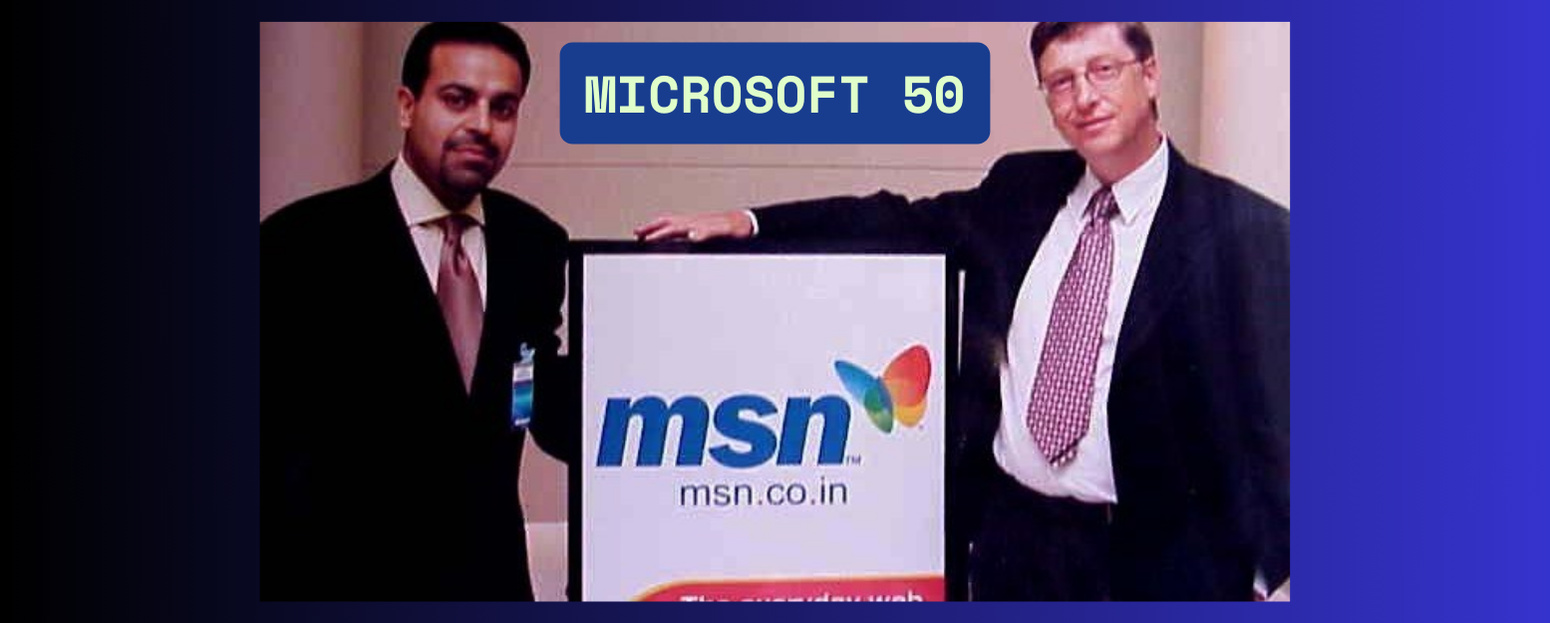
On April 4, 2025, Microsoft turned 50. It’s a significant milestone for a technology company that has seen the industry transform many times over—and yet remained relevant through all those shifts.
Founded by Bill Gates and Paul Allen in Albuquerque in 1975, Microsoft moved to Bellevue and later to Redmond, Washington, which has been its home ever since.
What makes Microsoft stand out is not just its size or past dominance, but its rare ability to reinvent itself multiple times—at least five, in fact—each time reimagining its position in the tech landscape.
Five pivotal shifts in Microsoft’s journey:
1. From command-line to GUI – betting on Windows
In the 1980s, Microsoft’s main product was MS-DOS, a text-based operating system. Around the same time, Apple brought in the Graphical User Interface (GUI), changing how users interacted with computers. Even while partnering with IBM to develop OS/2, Bill Gates quietly pushed ahead with Windows. That internal bet paid off when Windows 3.0 became a hit, and OS/2—despite being technically praised—faded into the background. Microsoft’s boldness in backing its own product over a joint venture shaped its future.
2. The internet wave and Internet Explorer
In the mid-1990s, when Netscape took the world online, Microsoft didn’t sit still. Bill Gates issued a now-famous memo, “The Internet Tidal Wave,” which led to the creation of Internet Explorer. Within a few years, it overtook Netscape and stayed dominant for over a decade. It was a powerful example of turning a potential threat into an opportunity by acting decisively.
3. Regulatory scrutiny and Google’s rise
Around 2000, Microsoft’s growing dominance led the U.S. Government to initiate antitrust proceedings. The case nearly split the company. While Microsoft defended itself and avoided a breakup, the years-long legal battle dulled its competitive edge—giving Google room to grow rapidly. Ironically, the legal tactics used in Microsoft’s defence later served as reference material when similar scrutiny fell upon social media giants.
4. Early to mobile, but late to win
Bill Gates saw the importance of mobile computing early on. Microsoft developed a mobile OS and even shipped smartphones by 2000, years before the iPhone. But it struggled to win over consumers and create a compelling app ecosystem. Meanwhile, Apple’s iPhone in 2007 and Android’s open ecosystem quickly overtook it. Despite serious attempts under CEO Steve Ballmer, Windows Phone never gained ground. Yet, Microsoft had already laid the foundation for its next act—cloud computing. Azure began as a quiet initiative under Steve Ballmer, but it would become central in the years to come.
5. Satya Nadella and a reset of priorities
When Satya Nadella took over in 2014, Microsoft had grown into a giant with internal silos, stalled products, and slowing momentum. He brought focus, humility, and clarity—shutting down loss-making products like Windows Phone, modernising Office as a cloud-first product, and doubling down on Azure. Most crucially, he made the bold, early investment in OpenAI, years before ChatGPT caught public attention. The launch of ChatGPT in 2022 was not a lucky moment—it was the result of years of strategic groundwork by Microsoft under Satya.
Organisations reflect their founders—and their geography
One of the most insightful observations in technology is this:
Companies are not just shaped by their business models; they reflect the character of their founders and the culture of their headquarters.
Microsoft reflects Bill Gates. He didn’t just bring intellect to the company—he brought a structured, lawyer-like obsession with clarity, precision, and numbers. While he didn’t formally study law, Gates’ father was a prominent lawyer, and that influence showed. Microsoft was among the earliest to license software with legal contracts, selling not just the software but the right to use it—a radical idea in the 1970s, when most software was shared freely. In 1976, Gates even published an “Open Letter to Hobbyists” defending software copyrights—arguably a foundational moment for today’s software business model.
Gates was also known for his intense leadership style. Executives and product teams presenting to him had to be ready for PQPA – Precise Question, Precise Answer. Within minutes, Gates would interrupt to ask hard, technically nuanced questions. If answers weren’t sharp, the room could get tense. But this rigorous environment created a culture of intellectual depth and data-driven decisions. It wasn’t about gut feeling—it was about whether you could defend your idea with logic, data, and clarity.

Microsoft also reflects Redmond. Unlike the hustle of Silicon Valley, Redmond, Washington is quiet, rainy, and surrounded by evergreens and mountains. Microsoft’s campus blends into that landscape—it’s low-rise, not a vertical glass-and-steel tower. The city doesn’t allow buildings taller than four storeys, preserving the area’s calm. That environment had a subtle but steady influence. Big decisions were made not in the chaos of downtown towers, but in peaceful offices that encouraged deep thinking.
During its early years, the campus had no restaurants nearby, so Microsoft offered free food to employees—a small gesture that turned into a culture of supporting internal productivity. Even today, free shuttles transport employees across its vast campus. It is a place designed for engineers to build, quietly but powerfully.
All this is more than trivia—it shows how much place and personality shape culture. Microsoft wasn’t just a software company. It was a place where law, numbers, engineering, and calm surroundings came together to shape a disciplined, ambitious, and methodical organisation.
A final thought
Having closely followed Microsoft—and having visited its Redmond headquarters many times as a partner from 1998 over the next two decades—I see its 50th anniversary as more than just a milestone. Microsoft is a classic example of the innovator’s dilemma: a market leader that risked being disrupted by the very changes it helped usher in. Yet, what makes its journey remarkable is how it has successfully reinvented itself more than five times—each pivot bold, and transformative. It’s a compelling case study in how even the largest organisations can adapt and thrive across generations of technology.
From DOS to Azure to AI, Microsoft continues to evolve—and the next fifty years may be even more interesting.
Footnote
The name “Windows” wasn’t always the first choice. During early discussions, one of the favoured names was “Interface Manager.” As the story goes, someone tried calling San Jose airport to ask for the “Interface Manager,” but the operator didn’t understand and disconnected the call. That made the team realise the name lacked clarity. “Windows” was then chosen instead—a name that stuck and scaled globally. This anecdote was published in the book “Inside Out: Microsoft – In Our Own Words”, by Warner Books, September 2000.
Discover more from Mangoidiots.com
Subscribe to get the latest posts sent to your email.