
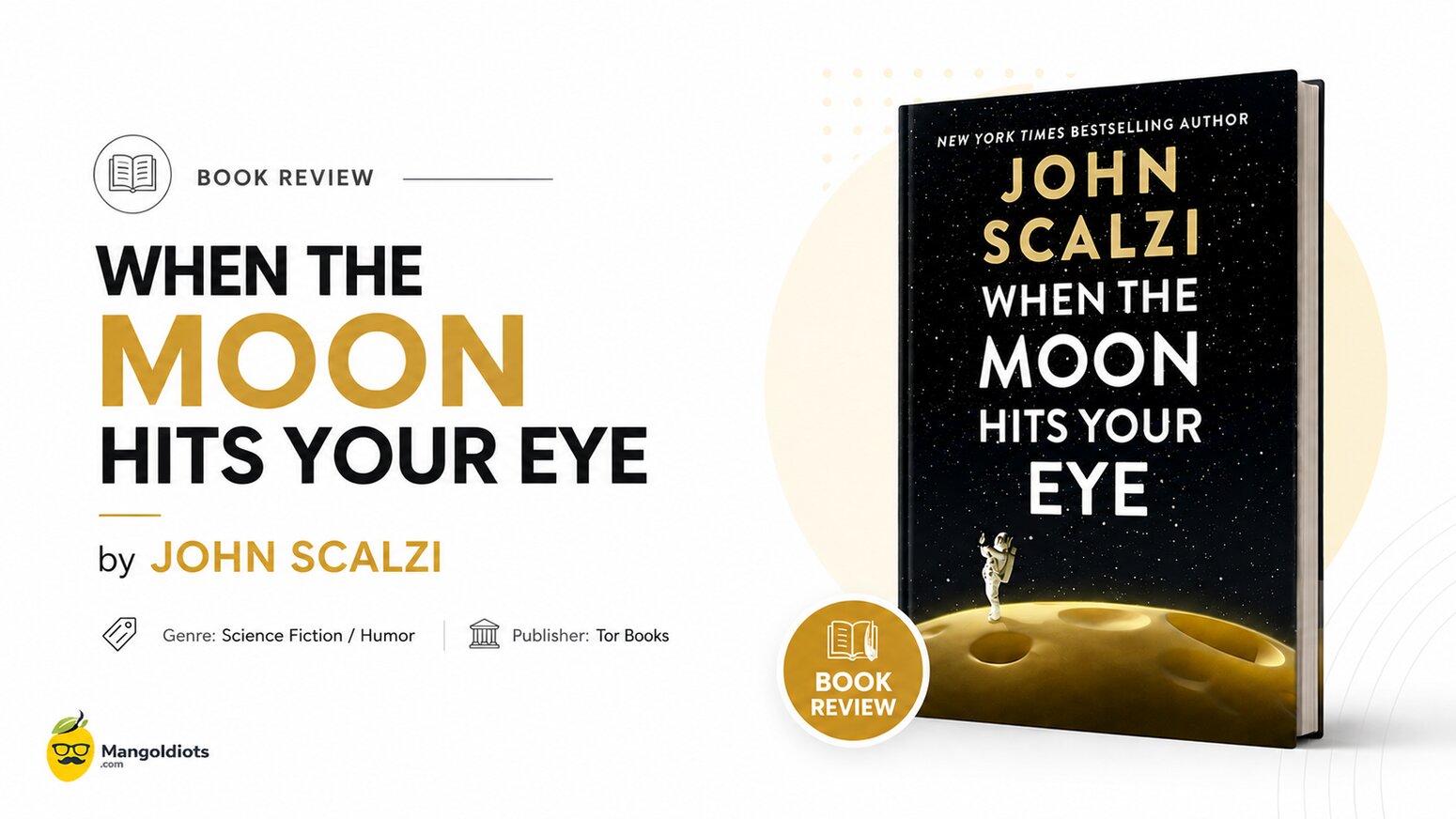
You will never look at the moon the same way after reading “When the Moon Hits Your Eye” by John Scalzi. The next time you step outside and glance at the moon, you may not see the familiar white sphere. Instead, you may end up imagining a giant yellow block of cheese hanging in the sky and smiling to yourself. There are quite a few curse words in the book, so I would hesitate to recommend it to younger readers. Otherwise, it is an enjoyable read for teenagers and adults, especially those who like unusual science fiction ideas.
I picked up this novel because the premise sounded completely ridiculous. A missing moon is still imaginable in science fiction. Aliens invading Earth is routine. But the moon turning into a giant block of cheese felt absurd even by sci-fi standards. What made me curious was not the event itself, but how the author would sustain an entire novel around such a strange idea.
To my surprise, John Scalzi manages to keep the reader engaged from the very first page. He does this without forcing us to constantly think about how silly the central plot is. The strength of the novel lies in the characters. Every chapter introduces people who feel real, familiar and believable. Even though the premise is impossible, the individuals reacting to it feel authentic. They remind us of people we may have met, worked with or read about before.
The core story unfolds over thirty days, with each day forming a chapter. It begins with a bizarre discovery in the United States, moon samples stored in museums suddenly turning into cheese. Interestingly, the book is not focused on explaining why this happened. Instead, it explores what happens afterwards. How do governments react? Scientists? Religious leaders? Billionaires? Families? Writers? Ordinary citizens?
The scientific explanation for the moon turning into cheese is obviously impossible, but society’s reactions feel surprisingly plausible. That balance is important. Without it, the story would have collapsed quickly for anyone with even a basic understanding of science, gravity or space.
The preface starts with a simple comparison. The moon’s diameter is roughly the distance between San Diego and Washington, DC. Somehow, presenting the size that way made the moon feel easier to visualise than the usual numbers in kilometres and miles.
Appropriately for a moon-related story, the novel opens at the Armstrong Air and Space Museum in Wapakoneta, Ohio. Reading this brought back a small regret for me. During my first visit to the USA in 1999, I visited the nearby United States Air Force Museum in Dayton, Ohio, but I missed this museum.
From there, we are introduced to Emily and Vigil, a working couple trying to manage their busy lives while still keeping up a weekly date-night dinner. Instantly, the story becomes relatable. Any parent juggling work and children will recognise the rhythm of their lives. Within a few pages, as the moon-cheese crisis begins unfolding, we already feel emotionally connected to them.
This ability to introduce entirely new characters and quickly make us care about them is one of Scalzi‘s biggest strengths. If there is one reason to read this book, it is this writing and not the science fiction element itself.
The next chapter shifts dramatically from that intimate domestic setting to the White House Situation Room. Suddenly, we are with a President facing a global crisis unlike anything humanity has seen before. Soon after, we meet astronauts preparing for a mission to the Moon, and we learn about their struggles and journeys to reach this stage in their lives.
NASA eventually confirms that the moon has transformed from basalt and anorthosite into what they officially describe as an “organic matrix”. Their serious scientific language for “cheese” was quite amusing to read.
The book keeps moving across different corners of society. We sit with retired people in casual-dining restaurants, discussing the cheese moon. One line from one of them stayed with me:
“Just because we want an explanation, just because we need an explanation, doesn’t mean the universe is obliged to provide one.”
That line felt uncomfortably true and stayed with me, long after I kept the book down.
We then meet the owner of a billionaire rocket company who is determined to outdo both Elon Musk and Jeff Bezos. It was engaging to read how he manipulates politicians and lawmakers even during a global crisis.
One of my favourite characters was a struggling writer hoping for a breakthrough success. Through him, Scalzi effortlessly captures the frustrations of writers and the realities of the publishing world. His unexpected success becomes one of the few genuinely positive outcomes of the cheese moon incident.
Elsewhere, we meet a teacher running a church Bible education programme for the kids. We encounter an eccentric, rich man obsessed with tasting moon cheese and the impossible tasks his exhausted manager must perform. Even the writers of Saturday Night Live are pulled into the chaos created by the moon event.
One of the highlights of the novel was the subtle handling of religion and faith through Pastor James Evans of Meadow Hill Church. Rather than becoming preachy or dramatic, the story stays grounded through the lives of James and Abby. They became one of the more memorable couples in the book.
While I enjoyed the constant introduction of new settings and characters, the structure became slightly tiring after some time. Just when you become invested in one storyline, the book jumps elsewhere. There were moments where I became impatient and wanted the story to return directly to the moon itself. Thankfully, the final chapters do return focus to the moon, and the way the conclusion is handled felt satisfying.
Overall, this is a light-hearted science fiction novel that is unlike most books in the genre. I would recommend it mainly to readers who are curious about the wonderfully strange premise of a cheese moon. Once you accept that idea, the book rewards you with memorable characters and surprisingly thoughtful observations about human behaviour.
Discover more from Mangoidiots.com
Subscribe to get the latest posts sent to your email.