
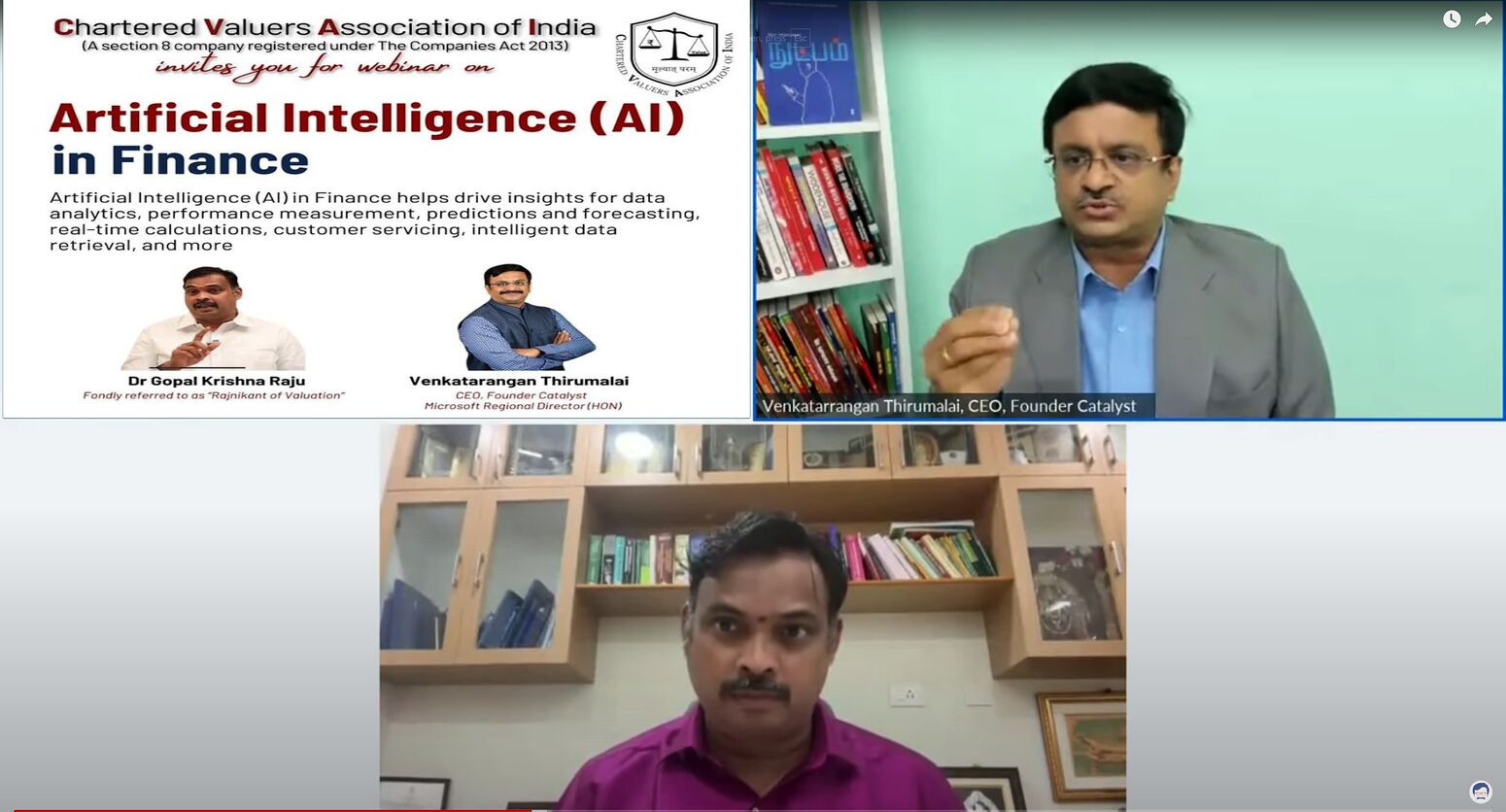
Yesterday, I had the pleasure of being interviewed by CA Dr. Gopal Krishna Raju, my schoolmate and a good friend, for an exclusive webinar on “Artificial Intelligence (AI) in Accounting,” presented by the Chartered Valuers Association of India (CVAI) & ZOHO Corp. Nearly a hundred financial and accounting professionals from around the country joined this interactive session.
The full recording of the webinar is here:
Some of the points we discussed in the interview are below:
Historical Context and Evolution of AI
- Early AI Concepts: AI has roots as far back as the 1300s with concepts of creating new knowledge from existing knowledge.
- Modern AI Development: The term ‘artificial intelligence’ gained prominence in the 1950s, particularly from a conference in 1956.
Key AI Concepts Explained
- Artificial Intelligence (AI): The ability of computers to perform tasks that typically require human intelligence
- Machine Learning (ML): A subset of AI where systems learn from data rather than explicit programming
- Deep Learning and Neural Networks: Advanced forms of ML that simulate the human brain’s network of neurons
- Generative AI: AI that can generate new content, such as text, images, and videos, from large data sets
- Large Language Models (LLM): AI models that understand and generate human-like text based on vast amounts of data
Practical Applications and Impact
- Finance and Banking: AI is transforming fintech companies by helping in fraud detection and financial analysis
- Job Market Impact: While AI may replace some repetitive jobs, it is expected to create new opportunities in more complex and value-added roles
- Educational Tools: AI tools like ChatGPT can serve as personalized tutors, enhancing learning by adapting to individual needs
- Fake Content Detection: AI’s role in detecting fake documents and ensuring the authenticity of scanned documents, particularly in finance
- Entertainment: AI is already being used to generate new movie content, including bringing back historical figures through digital re-creations
- Tax and Finance: AI tools are helping tax departments detect tax evasion through sophisticated data analysis models
Learning and Development in AI
- Educational Resources: Recommended resources for learning AI include ChatGPT for self-learning, YouTube tutorials, LinkedIn Learning, and professional courses on platforms like Udemy and edX
- Certifications: Various universities and institutions offer certifications in AI and related fields
Open Discussion and Q&A
- Blockchain and Security: Discussion on the role of blockchain in preventing financial scams and improving security in financial institutions
- AI in National Security: AI’s potential to assist in physical security and its critical role in maintaining national safety
It was a stimulating session filled with insightful discussions and questions from the audience. I look forward to more such opportunities to share and learn about the evolving role of AI in various industries.
Update November 2024:
We are continuing this discussion with this four-part mini-series, the recordings are available below.
Natural Language Processing on the 27th October 2024
Machine Learning and Analytics on the 3rd November 2024
Why Microsoft Copilot is the Game-Changer Your Business Needs Now on the 10th November 2024?
Discover more from Mangoidiots.com
Subscribe to get the latest posts sent to your email.